
It’s been a while, so let’s do a short recap. Our response to negative stressors in our external environment activates the four phases of our stress response in our internal environment: our biological, physiological, psychological and behavioural drivers.
In the biological and physiological phases of our stress response, our immune system is severely weakened; we are not fully protected and cannot fight off viruses, colds, flus, inflammation, infections or disease properly. This means we get sick more often and for longer periods.
When you are overwhelmed with stressors, you trigger a chronic stress response that activates the production of chronic stress hormones. In chronic stress, your body is trapped in ‘attack mode’ by the chronic stress hormones flooding your bloodstream. Put simply, you are working against your stress response system by not allowing it to bring your body back to ‘rest, restore, relax’ mode. Notice I said ‘you’, not stress or hormones, you.
Keeping your body in chronic stress also weakens your immune system. So an already weakened system gets weaker; it’s cumulative. Are we all noticing this vicious circle? This is the path to burnout; we burn out our own stress response system.
The chronic stress response is a long-term stress response that triggers chronic inflammation. Chronic stress leads to systemic inflammation. This is when the body starts to attack itself. Stress also plays a part in every case of life-threatening infections. By suppressing T cells, stress also plays a part in diabetes, asthma, ulcers, heart disease, circulation problems, heart attacks and makes all mental illnesses worse. There is now no doubt that 75%-90% of physical and mental illness and disease is related to the activation of our stress response.
So, what can you do to avoid all this illness and disease? You can work with your stress response system by allowing it to bring your body back to ‘rest, restore and relax’ mode. This built-in repair unit demands time to do its job. How do we give it time? By simply taking a time-out from responding to stressors and turning down your fear and anger responses. Unfortunately, most of us have no idea we have this built-in repair unit.
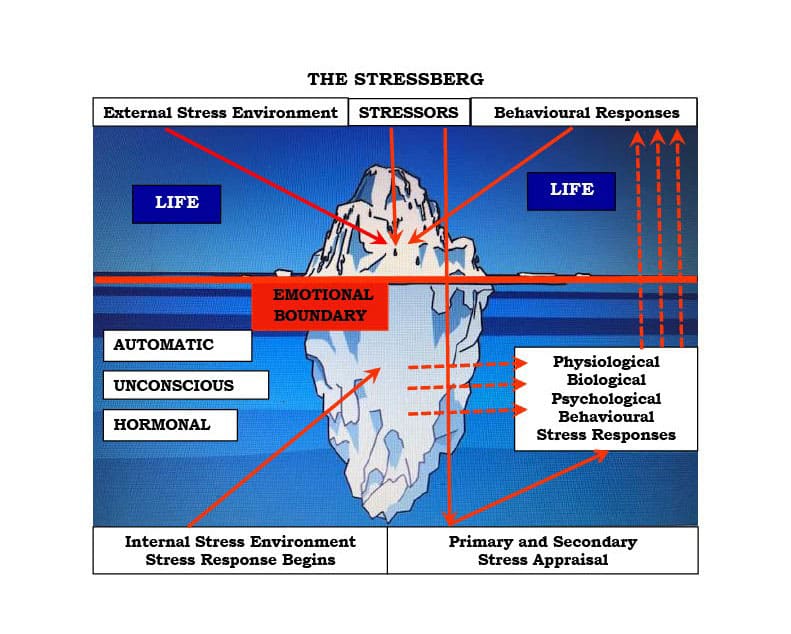
To get a better understanding, have a look at the stressberg. It sounds a bit corny, I know, but it’s the best I could come up with. If it looks like an iceberg, that’s because it is. I wanted to give you a visual of how much of your internal environment is involved in your biology, physiology, psychology and behavioural drivers, and where these are located.
Like the iceberg, most of the activity that forms and drives the stressberg starts and stays deep under the emotional boundary, and, as you can see, this is the biggest part of the stressberg.
The stressberg represents our stress response system. The peak above the waterline represents the world we live in, where all our stressors are. The waterline represents our emotional boundary; the fine line between our internal and external worlds. The biggest part under the emotional boundary represents our internal environment; our unconscious world where we trigger our own stress responses; our automatic biological, physiological, psychological and behavioural activations that form and drive our behavioural responses in our external world. All these automatic activations start and stay in our unconscious world under the emotional boundary, in the deepest part of the stressberg.
Most of us are not aware of these unconscious activations, even though our bodies and psychology send us physical (headaches, digestive problems, inability to sleep and more) and emotional (irritability, lack of interest, drinking too much alcohol, taking drugs and more) signs and symptoms of stress response.
We generally ignore these until the little peak, sticking out above our emotional boundary in our external world – the smallest part of the stressberg, and the last and only phase of our stress response we’re all aware of – demands a behavioural action from our unconscious biological, physiological, psychological and behavioural drivers, and all of a sudden, we find ourselves in the middle of an argument, avoiding responsibilities, breaking promises, hurting our relationships or engaging in escape behaviours in our external world. Is the vicious circle clearer now?
As you can see, your stress response is complicated and multi-layered. It’s not as simple as getting annoyed at something or someone else and blaming them for stressing you out. It’s so much more than your behavioural response; it’s deep, automatic, unconscious, and hormonal.
It starts long before you even think about responding to a particular stressor and, once activated, you have no control over it. If you leave the chronic stressor unresolved, your biological activation of chronic stress hormones will, over time, continue to devastate your mental and physical health. However, with a bit of practice, you can learn to prevent this by simply reducing and managing the number of stressors in your life and remembering to switch on the Brake (your hormonal brake) by allowing your system to activate your ‘rest, restore, repair’ neurotransmitter GABA, when you need to turn down your fear and anger responses.
This can be as simple as enjoying a nice meal, talking to a good friend, taking a walk, enjoying a hobby, exercising, going inside, or sitting still and doing belly breathing for three minutes. You see, it’s not doing these things that matters; it’s the hormones and neurotransmitters they release that benefit our health and wellbeing. These happy hormones and neurotransmitters produce happy feelings, thoughts, and emotions. These deplete the stress hormones and protect our health and wellbeing. This is how we ‘hack’ our stress response system by simply
triggering dopamine, serotonin, endorphins, oxytocin, our ‘feel-good’ hormones, and GABA when necessary.
When we understand the brain-body connection, we understand what stress and burnout are, when they begin, how they present physically, mentally, emotionally and where they end. It’s all about hormones and neurotransmitters!
Joan Maycock, MSc Health Psychologist, specialises in stress and burnout education, designing, setting up, and presenting Stress and Burnout Educational Retreats, Workshops, and 1-on-1 sessions for private and corporate groups in Ireland. Email:[email protected]